 NextNeural
NextNeural Intel Deep Dive: Unlocking the Hidden Patterns in Your Sales Conversations
Your sales floor is churning out a thousand calls a day across six different states and four different languages.
Somewhere in these calls, a rep told a customer the wrong interest rate. Another one promised a callback that never happened. A third handled a tough objection so well that everyone should hear how she did it.
Not to mention, your rep in Bengaluru is pitching in Kannada, your team in Mumbai is handling objections in Marathi, and your Delhi managers are trying to make sense of it all in Hindi and English. As a supervisor, you have only a partial view of what’s happening across your team. You physically cannot know what is happening in every call, and are unsatisfied at the thought of randomly sampling a few recordings just to grade a rep’s performance for QA.
If you run sales, collections or support in India, this probably sounds familiar. In high-volume Indian operations, manual call review leaves huge blind spots. Managers typically only have the bandwidth to review about 1% to 2% of total calls, leaving teams guessing about what actually works and what doesn’t.
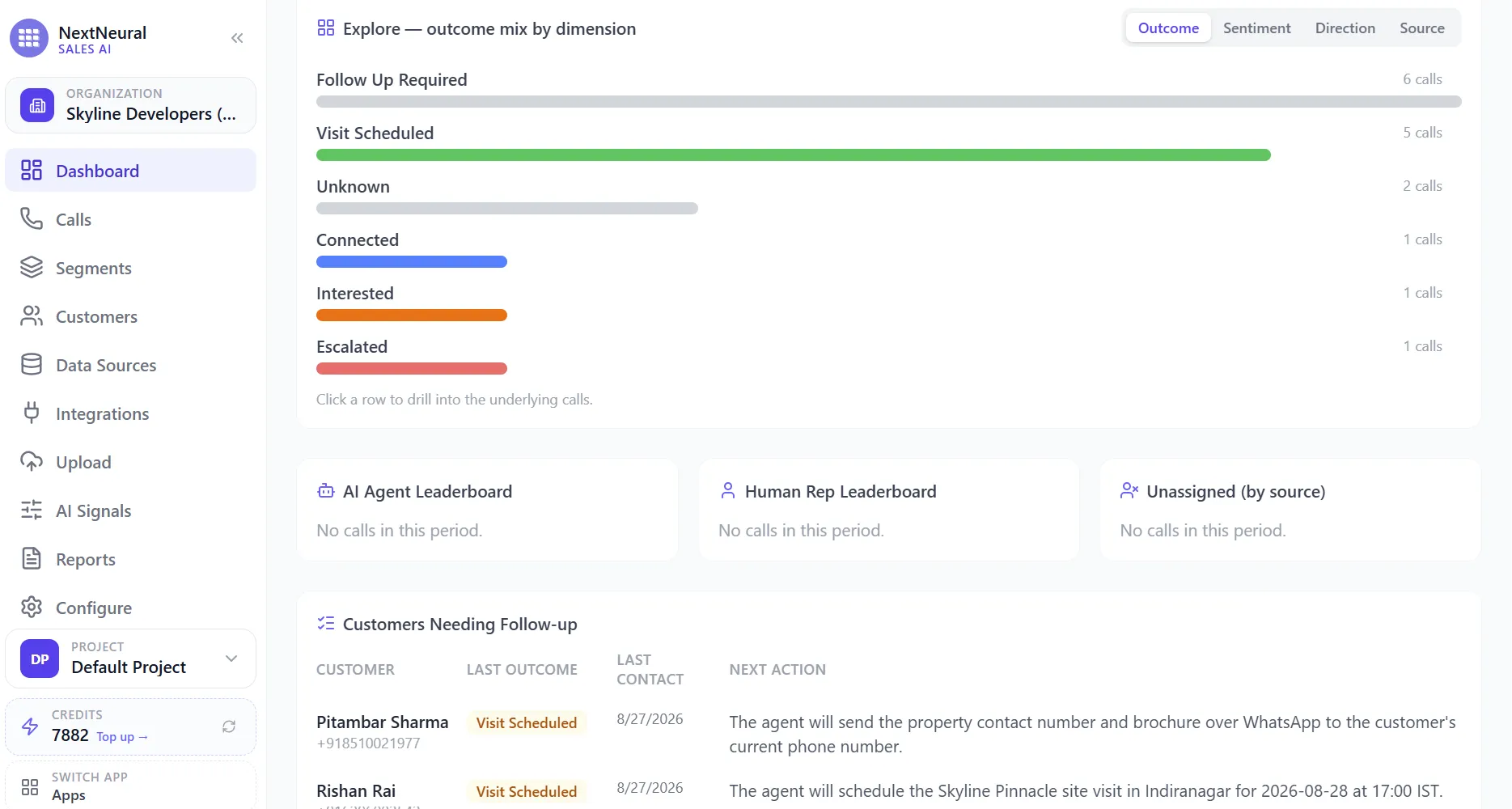
NextNeural Intel solves this for you.It uses AI to analyze customer conversations, pick out the signals that matter, and score each interaction against criteria that fit your business. So instead of leaning on transcripts or a small QA sample, you can see what’s happening across far more of your calls.
What is NextNeural Intel?
NextNeural Intel is an AI-powered conversation intelligence platform that analyzes, evaluates and scores customer conversations at scale.
A recording holds a lot of information, but nobody can listen to every one. Transcription helps, because it makes calls searchable. But a transcript won’t tell a manager whether the call went well, whether the customer was serious, or whether the agent followed the process.
NextNeural Intel adds that missing layer. It looks at each conversation for things like customer intent, payment intent, sentiment, script and process adherence, objection handling, compliance, promises to pay, agent behaviour, overall conversation quality, and what the customer is worried about or asking for.
Here’s the simple version. A transcript tells you what was said. Conversation intelligence helps you understand what happened. Conversation scoring tells you how the call performed against what your business is trying to achieve.
Why customer conversations are an untapped source of intelligence
Your CRM knows a customer was contacted. It may even record the outcome or the stage of the deal. But the real context sits inside the conversation, and it rarely makes it into any system.
A customer might say:
“I want to make the payment, but I will need until next Tuesday.”
Or:
“The product looks good, but the pricing is higher than what I expected.”
Or:
“I have already spoken to three people and nobody has resolved this issue.”
Each of those lines carries intent, urgency, an objection, a mood, a risk or a next step. Now imagine trying to pull those out by hand across thousands of calls. It doesn’t happen.
NextNeural Intel turns these unstructured conversations into structured information you can analyze at scale.
How does NextNeural Intel score every customer conversation?
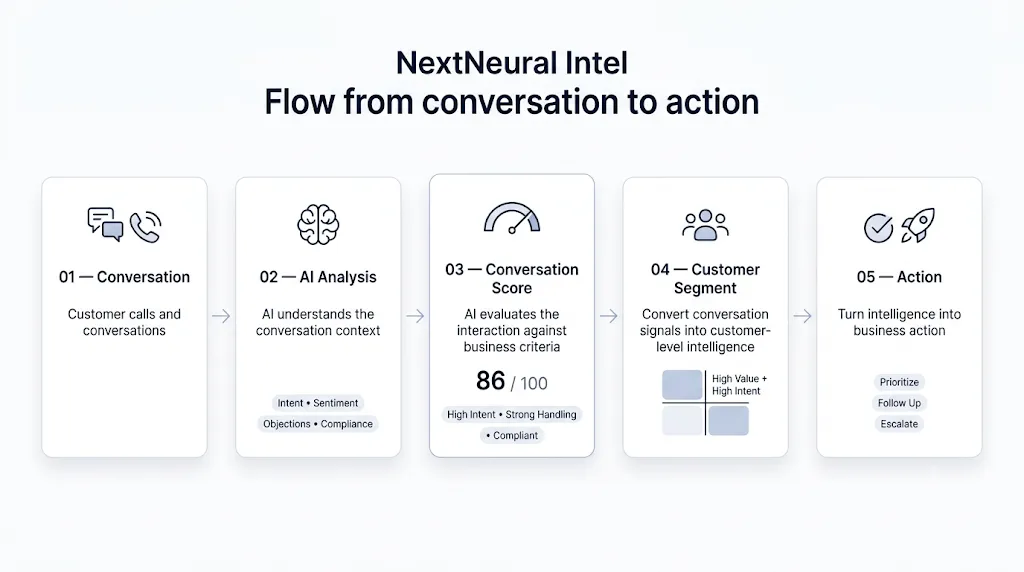
It scores each call against criteria built around your business goals. Think of it as a simple chain: conversation, AI analysis, signal detection, scoring, action. Here’s how each step works.
1. It captures and processes the call
NextNeural Intel takes in conversation data from your existing calling or telephony setup, then processes the speech and language.
2. It understands what’s being said
The AI reads the context of the whole interaction, not just isolated keywords. It works out what the customer wants and what’s worrying them, how the agent responded, whether the customer showed real intent, whether anyone made a commitment, and whether the required process was followed.
3. It picks out the signals that matter to you
Which signals it’s picking on depends on your business. A lender might look for payment intent, promises to pay, the reason behind non-payment, customer sentiment and escalation risk. A sales team might care more about purchase intent, objections, competitor mentions, product interest and next steps.
4. It scores the conversation
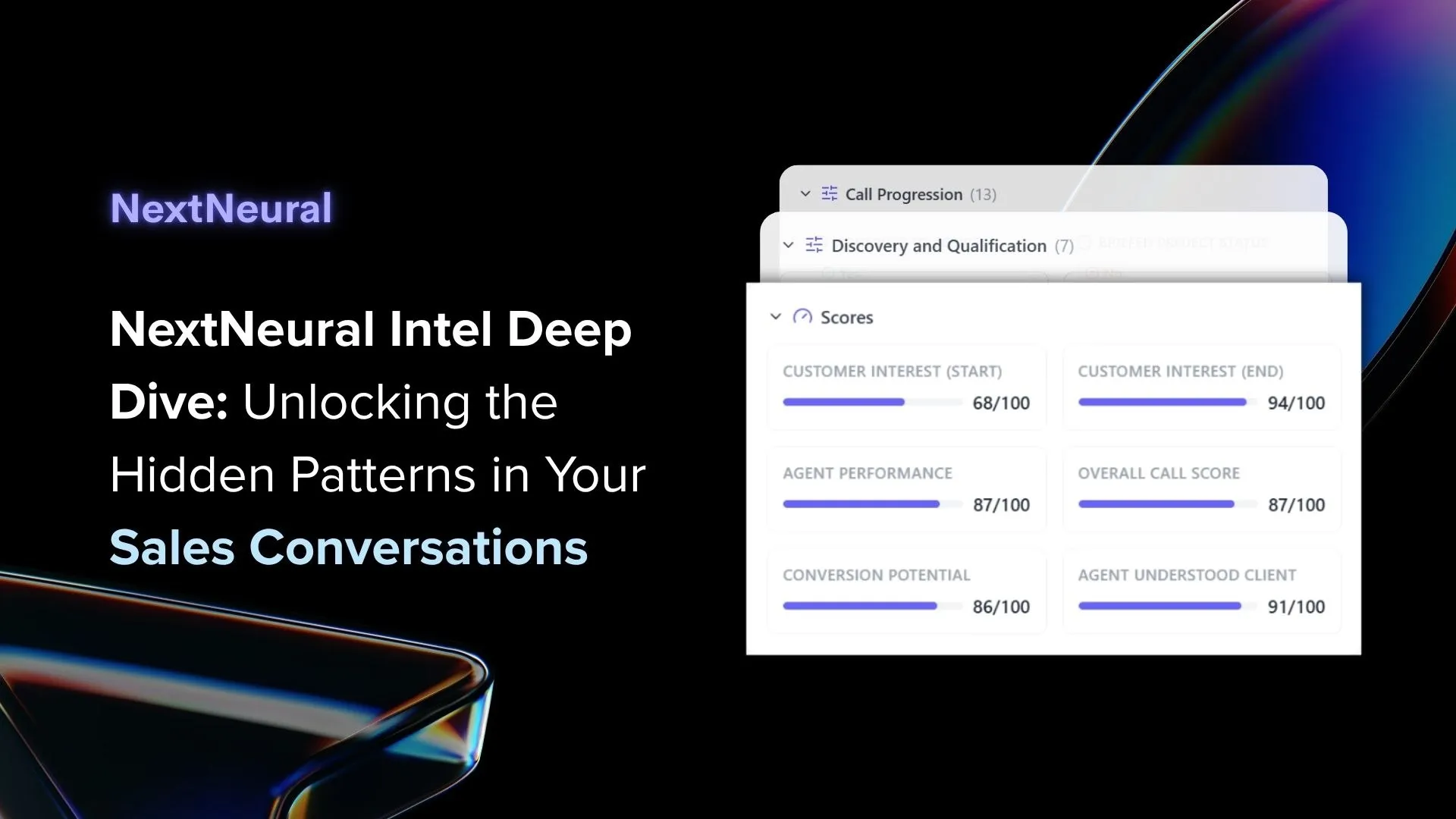
Those signals are then measured against the scoring criteria you set. A scored call might look like this:
Conversation Quality Score: 86/100
Customer Intent: High
Script Adherence: 92%
Objection Handling: Strong
Sentiment: Neutral
Follow-up Required: Yes
You can shape the scoring framework around your own workflows and goals.
5. It surfaces what your team can act on
What comes out isn’t another transcript. Managers can see which calls need attention, which customers need a follow-up, and which behaviours make good coaching material.
What does NextNeural Intel analyze?
The exact signals change with the industry and the use case, but a few categories matter for almost every customer-facing team.
Customer intent
The AI can tell whether a customer sounds interested, unsure, unwilling or ready to act. For a sales team, that’s purchase intent. For a collections team, it’s payment intent.
Sentiment
It reads the tone and context of the call, and how the mood shifts along the way. That helps you spot frustration, dissatisfaction or genuine engagement without hearing the call yourself.
Script and compliance adherence
Most organizations have steps their agents are expected to follow. Scoring can check whether the right questions were asked, the required disclosures were made, and the conversation followed the process.
Objection handling
Objections are a big part of sales and support calls. The AI can evaluate how an agent responded to concerns about pricing, competitors, product features, payment terms and more.
Customer commitments
Collections and other customer-facing work is full of commitments: a promise to pay, a callback request, an appointment confirmation, a follow-up, an escalation request. Pulling these out makes it much easier for your team to follow through.
Multilingual conversation intelligence for Indian teams
Customer conversations in India don’t stick to one language.
One organization can handle Hindi, English, Bengali, Tamil, Telugu, Marathi, Kannada and other regional languages, plus mixed speech like Hinglish, all on the same day. NextNeural Intel analyzes conversations across supported Indian languages, so you can apply the same evaluation framework to teams spread across the country. A supervisor doesn’t have to listen to every regional-language call just to understand what matters in it.
And the goal isn’t just to translate the call. It’s to understand it in its business context.
Fluent in Hinglish: Why US-Centric Tools Fail Indian Sales Teams
Enterprise tools like Chorus are incredibly popular in the US, but they share a fatal flaw when deployed in our market: they don’t speak our language. They are trained on North American accents and standard English. But anyone who has ever closed a deal in India knows that conversations don’t happen in perfect English. Prospects switch to Hindi mid-sentence, negotiate in Hinglish, and communicate with distinct regional accents. When an American AI tries to transcribe this, critical deal signals turn into gibberish.
NextNeural Intel is built for the reality of Indian sales—capturing the exact cultural nuances, code-switching, and objections that Chorus misses.
1. The Code-Switching Advantage (Hinglish, Tanglish, and beyond)
An Indian sales call is rarely 100% English. A prospect might say, “The features are good, but pricing thoda high lag raha hai,” or “Can we do this next quarter? Abhi budget ka issue hai.” US-centric platforms typically transcribe these rapid linguistic shifts as errors, entirely missing the context.
NextNeural Intel is built for how India actually speaks. Our AI engine natively understands code-switching, seamlessly translating transitions between English and regional languages like Hindi, Tamil, Telugu, and Marathi within the exact same sentence. No context is dropped, and no deal signal is lost in translation.
2. Pinpoint Accuracy Across Indian Accents and Dialects
Even when a conversation happens entirely in English, the cadence, pronunciation, and regional accents of Indian buyers regularly cause transcription failures in American-made models.
NextNeural’s AI is trained extensively on diverse Indian voice data. Because our underlying speech-to-text accuracy is fundamentally tailored to this region, the insights generated—from pricing objections to competitor mentions—are genuinely reliable, regardless of which part of the country the buyer is calling from.
3. Decoding Indian Buying Behavior and Nuance
An American buyer pushes back on price very differently than an Indian buyer. US tools are trained to scan for blunt, direct objections. However, Indian sales rely heavily on relationship-building, extended negotiation, and indirect pushback. A polite “Let me discuss with my management and get back to you” often means a deal is quietly stalling out, not moving forward.
NextNeural Intel goes beyond raw transcription to read between the lines, fine-tuned to capture the cultural nuance, sentiment shifts, and negotiation tactics unique to the Indian buyer journey.
From Conversation Scores to Business Actions
Insights only help when they reach the systems your teams already use.
NextNeural Intel can connect with your CRM and with sales or operations platforms, so conversation-level insights become part of your normal workflow. In practice:
High customer intent → Priority follow
Compliance exception → Supervisor review
High-risk conversation → Escalation
Strong sales interaction → Coaching example
Promise to Pay identified → Follow-up workflow
So the path runs from conversation to score to CRM to action.
Conversation → Score → CRM → Action
Nothing sits in a separate dashboard waiting for someone to remember to check it. The insights plug into the processes your sales, collections, support and operations teams already run.
Conversation Intelligence for Sales, Collections and Support
The same platform works across different customer-facing teams.
Sales teams
Sales managers can find high-intent conversations, see which objections keep coming up, and understand what stronger calls have in common. The best conversations also become coaching examples the rest of the team can learn from.
Collections teams
Collections conversations tell you a lot about whether a customer is willing and able to pay. NextNeural Intel can pick out payment intent, promises to pay, reasons for delayed payment, customer sentiment, escalation signs and follow-up needs.
You can then combine these signals with details like loan value, product, risk or payment history. A high-value borrower who clearly intends to pay needs a different follow-up from someone who shows little intent. That lets your team go beyond counting calls and start building customer segments that mean something.
Support teams
Support calls are full of clues about repeat issues, product problems and the overall service experience. When you analyze them at scale, patterns show up that stay invisible across individual calls.
What does an AI-scored conversation look like?
Take, for example, a collections call. The borrower tells the agent:
“I am waiting for my salary to come in. I should be able to make the payment next Tuesday.”
Left in an audio file, that detail is easy to lose. NextNeural Intel pulls out the relevant signals and structures them:
| Signal | Result |
|---|---|
| Payment Intent | High |
| Promise to Pay | Yes |
| Expected Payment | Next Tuesday |
| Sentiment | Neutral |
| Follow-up Priority | High |
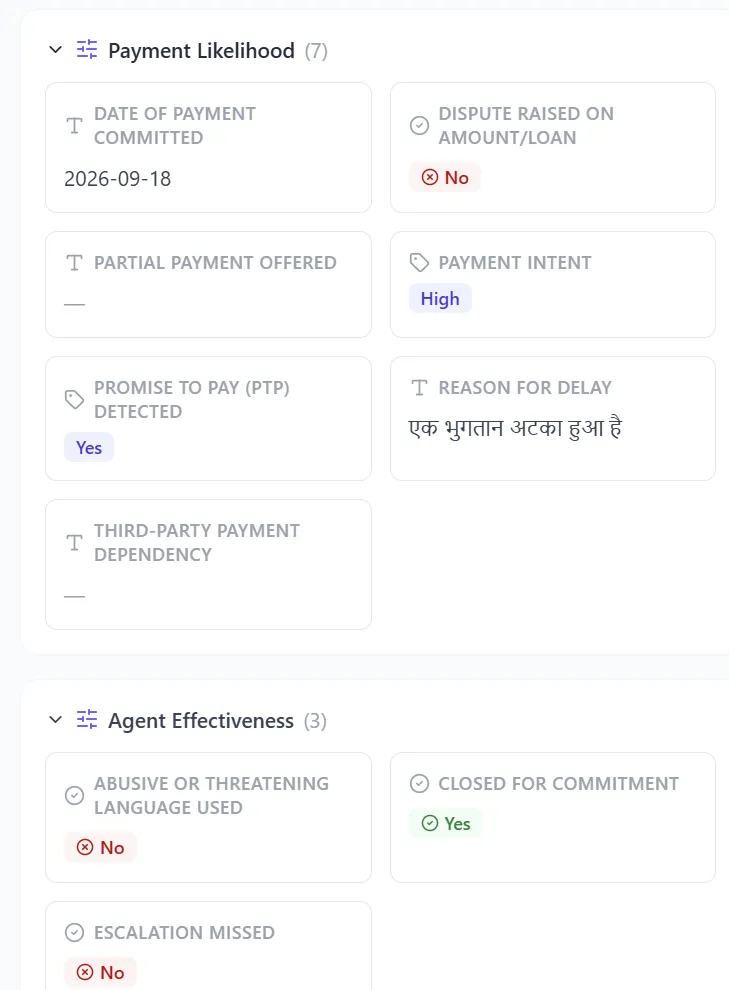
A supervisor gets a clear picture of the call without listening to all of it. The same idea works for sales and support calls, with the scoring criteria adjusted to what you’re trying to achieve.
Sovereign deployment for sensitive customer data
If your teams handle sensitive customer conversations, where that data is processed and stored matters. It matters most in BFSI, healthcare and telecom, where security, privacy and data governance requirements tend to be strict.
NextNeural Intel can be deployed on-premise, on AWS, on Azure or on GCP, depending on what your organization needs. You keep more control over where conversation data is processed, stored and accessed, and you still get AI-powered conversation intelligence inside your existing tech environment.
Regulatory and compliance needs differ by industry, deployment setup and the rules that apply to you, so check the specifics with your own team.
Turn Customer Conversations Into Actionable Intelligence
Every customer call holds information about intent, sentiment, objections, requirements, commitments and outcomes. The hard part is turning it into something your teams can use every day.
NextNeural Intel brings together conversation analysis, AI-powered scoring, multilingual understanding and workflow integration, so you can see what’s happening across your customer interactions at scale. Instead of storing recordings you’ll never replay, you can use them for QA, coaching, customer prioritization and better decisions.
Ready to see what your conversations can tell you?
Book a Demo to see how NextNeural Intel can analyze and score your customer conversations.
Ready to Transform Your Business with AI?
Join NextNeural today and deploy production-ready AI agents in minutes.
Build an Agent