 NextNeural
What Is Call Intelligence Software? A Complete Guide
If you run a sales or call center team, the real problem is visibility: you can’t see what’s actually happening on the calls your team makes every day. Deals stall and you find out after they’re already lost. Coaching gets built on the two or three calls you happened to sit in on — a thin, random slice of a rep’s real pattern across hundreds of calls. A missed compliance disclosure surfaces when an auditor flags it, months after it happened. Every one of those is a visibility gap, and visibility gaps show up directly in your numbers: slower ramp times, inconsistent win rates across reps doing the “same” job, and regulatory exposure you can’t quantify until it’s already a problem.
A rep finishes a call, jots down three lines in a notes field, and moves to the next one. The other 95% of the conversation — the hesitation in a prospect’s voice when you mention renewal terms, the exact phrase a top performer used to defuse a pricing objection, the moment a customer mentioned a competitor by name — disappears. It was never recorded as data. It was just talk.
Call intelligence software exists to close that gap. It’s the category of tool that listens to every call your team makes or takes, turns the audio into structured, searchable data, and surfaces what actually happened — not what the rep remembers happening.
This guide covers what call intelligence software actually does, how it works under the hood, how it differs from call recording and basic speech analytics, and what to look for if you’re evaluating one for a sales or call center team.
What Is Call Intelligence Software?
Call intelligence software (sometimes called conversation intelligence) is a category of AI tool that transcribes, analyzes, and extracts structured insight from voice conversations — typically sales calls, but also support and collections calls. Instead of leaving a call as an audio file sitting in a telephony system, it turns that call into data your team can query, score, and act on.
At a functional level, most call intelligence platforms do five things:
- Transcribe the call with speaker separation, so you know who said what and when.
- Analyze the conversation for sentiment, talk-time balance, keyword mentions, and objection patterns.
- Score specific behaviors — objection handling, compliance adherence, discovery quality — against a defined rubric.
- Surface deal-relevant signals like buying intent, competitor mentions, and risk indicators to managers and reps.
- Sync the extracted insight back into the CRM or coaching workflow automatically, without manual data entry.
The category grew out of a simple observation: sales and call center managers were already recording calls for quality assurance, but almost nobody had time to actually listen to them. Call intelligence software replaces the manual QA sample — where a manager might review 2-3% of calls a rep makes in a month — with full coverage, because automating the analysis removes the time limit that capped manual review in the first place.
Why Sales and Call Center Teams Need This Now
Three structural problems in phone-heavy sales and support teams make manual call review unsustainable, and call intelligence software exists specifically because of them.
Coaching is subjective when it’s based on memory
When a sales manager gives feedback after “sitting in” on a handful of calls, that feedback is shaped by whichever calls they happened to catch — not by patterns across the rep’s full call volume. Two reps with identical actual performance can get very different coaching depending on which of their calls a manager randomly reviewed.
Buying signals get missed because nobody is listening in real time
A prospect mentioning “we have budget approved for Q1” or “I need to check with our compliance team first” is a concrete signal a deal is progressing or stalling. If that phrase lives only in an audio recording nobody replays, it never reaches the CRM, and the next person who touches the account has no idea it was said.
Compliance risk compounds silently
In regulated environments — lending, insurance, collections — a rep who skips a required disclosure on one call is a training gap. A rep who skips it across hundreds of calls over a quarter is a regulatory exposure. Without systematic review of every call, that pattern is invisible until an audit or a complaint surfaces it.
Call intelligence software addresses all three by making full-coverage review the default: every call gets the same analysis, whether or not a manager ever had time to sit in on it.
How Call Intelligence Software Actually Works
Under the hood, most platforms — including NextNeural’s own call intelligence agent, NN Intel — run a call through a consistent pipeline. It’s worth understanding each stage, because the quality of the output depends entirely on how well each step is done.
1. Call capture and transcription
The platform connects to your telephony system, dialer, or conferencing tool (Zoom, Teams, a VoIP provider) and ingests calls either live or from recordings. Transcription models convert the audio to text with speaker diarization — separating rep speech from prospect speech — and timestamps every utterance. Good transcription handles accents, overlapping speech, and industry jargon; this is the stage where quality varies most between vendors, since a noisy or inaccurate transcript corrupts every analysis step downstream.
2. Sentiment and tone tracking
Rather than scoring a call as simply “positive” or “negative,” sentiment tracking maps emotional tone across the timeline of the conversation — flagging exactly when a prospect’s tone shifted, and tying that shift to what was being discussed at that moment. A dip in sentiment right after pricing is mentioned tells you something specific and actionable; an overall “60% positive” score for the whole call tells you almost nothing.
3. Keyword and signal detection
The system scans for defined triggers: competitor names, pricing terms, compliance-sensitive phrases, and buying-intent language (“decision by,” “budget,” “next steps”). This turns unstructured conversation into a tagged, searchable index — a manager can filter every call from the last month that mentioned a specific competitor, for instance.
4. Objection handling and script adherence scoring
The platform identifies moments where a prospect raises an objection and evaluates how the rep responded, typically against a rubric built from what top performers do in similar moments. In regulated industries, the same mechanism checks whether required disclosures were made at the right point in the call.
5. Automated CRM and coaching sync
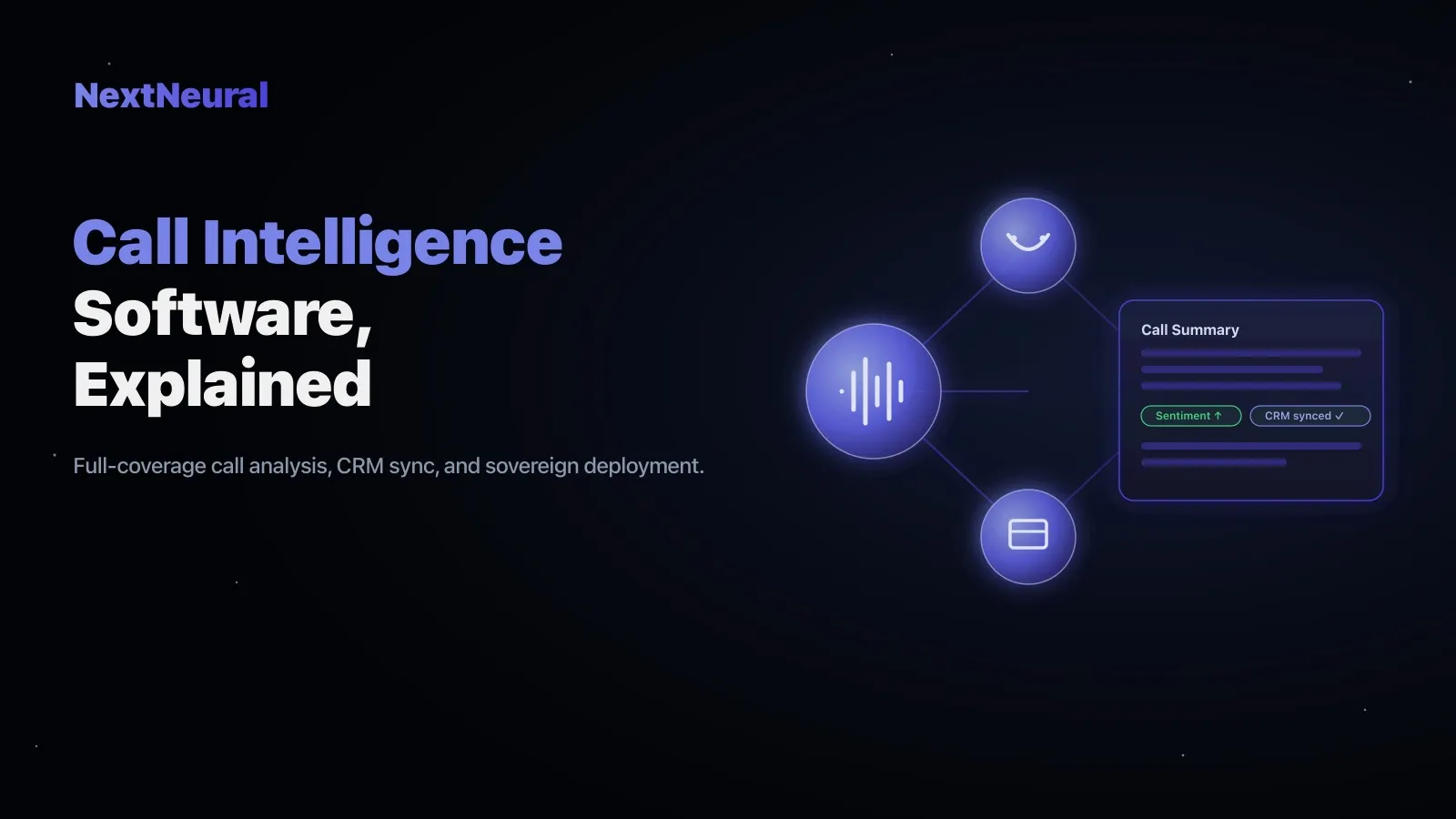
The output of all of the above — call summary, sentiment timeline, flagged moments, extracted action items — gets written back into the CRM against the relevant contact or deal record, and into a coaching dashboard for managers. This is the step that turns call intelligence from “another dashboard to check” into something that fits inside the workflow reps and managers already use.
The value of call intelligence software isn’t the transcript. It’s what gets extracted from the transcript and where that extraction ends up — a CRM field, a coaching alert, a compliance flag — without anyone having to type it in manually.
Call Intelligence vs. Call Recording vs. Speech Analytics
These three terms get used loosely and interchangeably, but they describe meaningfully different levels of capability. Knowing the distinction matters if you’re evaluating tools, because vendors will sometimes market a recording tool using intelligence-category language.
| Capability | Call Recording | Speech Analytics | Call Intelligence |
|---|---|---|---|
| Stores audio for playback | Yes | Yes | Yes |
| Full transcription with speaker separation | No | Usually | Yes |
| Keyword / phrase spotting | No | Yes | Yes |
| Sentiment mapped to conversation timeline | No | Limited | Yes |
| Objection handling / win-pattern scoring | No | No | Yes |
| Automated CRM field updates | No | No | Yes |
| Deal-outcome / risk prediction | No | No | Yes |
Call recording is just storage, and speech analytics adds a layer of usually keyword-based pattern detection on top of that storage. Call intelligence goes further: it interprets the conversation, scores behavior against a rubric, predicts outcomes, and writes structured insight back into the systems your team already works in. A tool that can only tell you that certain words were said is doing speech analytics. One that can tell you why a call went well or badly has earned the “intelligence” label.
What to Look for When Evaluating Call Intelligence Software
If you’re comparing platforms, these are the criteria that actually separate a useful deployment from a dashboard nobody opens after week two:
- Full coverage. It should analyze every call the team makes — that’s the entire point of automating a process that used to run on a small QA sample.
- Native CRM and telephony integration. If insights require someone to manually copy data from one system to another, adoption drops off fast. Confirm the vendor supports your actual CRM (Salesforce and the rest) and your actual telephony layer (Twilio, Exotel, Plivo, or whichever provider you’re on) before you get deep into a proof of concept — a platform that only integrates with systems you don’t use is a poor evaluation candidate.
- Configurable scoring rubrics. Objection handling and compliance requirements differ by industry and by company — a fixed, non-configurable rubric won’t map to your actual sales process.
- Explainability. A sentiment score or win-probability number is only useful if a manager can click into the exact moment in the call that produced it.
- Where the data actually lives. This is the criterion most buyers skip, and it’s the one with the most downstream risk. Ask specifically whether the vendor’s transcription and language models run on their own hosted infrastructure, and whether transcripts get sent to a further third-party model API behind the scenes — the answer usually isn’t volunteered unless you ask directly.
CRM and Telephony Integrations: Where Call Intelligence Actually Plugs In
A call intelligence platform is only as useful as the systems it connects to. Analysis that stays trapped in a standalone dashboard just becomes one more tab nobody opens — the value shows up when insight lands automatically inside the CRM a rep already lives in, sourced from the telephony stack that’s already routing the call. Two integration points matter most in practice: the CRM the sales team runs on, and the telephony or dialer layer the calls actually travel through.
Salesforce and CRM sync
Salesforce remains the default CRM for a large share of mid-market and enterprise sales orgs, and it’s the integration most call intelligence buyers ask about first. NN Intel connects to Salesforce directly, writing call summaries, sentiment timelines, extracted action items, objection-handling scores, and flagged compliance moments back onto the relevant Lead, Contact, or Opportunity record — without a rep having to open a second tool or copy anything by hand. Deal-stage signals picked up mid-call — a prospect confirming budget, or asking to loop in procurement — can trigger Salesforce workflow updates the moment they’re detected, closing the gap between when something happens on a call and when a rep gets around to logging it. The same sync pattern extends to HubSpot, Zoho, and custom-built CRMs through a REST API; Salesforce just tends to be the first one teams evaluate.
Telephony: Twilio, Exotel, and Plivo
The other half of the integration is upstream of the CRM: the telephony layer that’s actually carrying the call. For teams running outbound or inbound calling programs in India and other non-US markets, that layer is rarely a traditional PBX — it’s a cloud telephony API. NN Intel connects directly to the three providers most common in this market:
- Twilio — for teams running global or India-plus-international calling programs, using Twilio’s Voice API and call recording webhooks to stream audio into the analysis pipeline as calls happen.
- Exotel — widely used by Indian BFSI, D2C, and collections teams for cloud telephony and IVR; NN Intel ingests call recordings and metadata through Exotel’s call APIs without requiring a change to the existing dialer setup.
- Plivo — another common cloud telephony layer for Indian outbound and support operations, integrated the same way: recordings and call events stream into NN Intel as calls happen, rather than sitting in a batch upload queue.
In each case, the integration sits at the telephony-provider level, so reps keep dialing and answering exactly as they do today. Calls keep flowing through the same numbers, the same IVR flows, and the same dialer your team already uses — NN Intel taps into the call stream and recording webhooks from the provider side, which means onboarding is a connection, not a phone-system migration.
The Data Sovereignty Problem Most Call Intelligence Tools Ignore
Sales calls contain some of the most sensitive data a company handles — customer PII, financial details, health information in some industries, and in BFSI or insurance, data that’s directly regulated. Most call intelligence vendors are SaaS-only: your call recordings and transcripts get uploaded to the vendor’s own cloud infrastructure for processing, and often to further third-party subprocessors (transcription APIs, LLM providers) behind that.
For companies operating under RBI-style data localization requirements, or any organization with a formal policy against sending customer conversations to external servers, that architecture is a hard blocker. It ends an evaluation regardless of how good the rest of the feature set looks.
Why NN Intel runs open-weight models on client infrastructure
The part of this that’s easy to gloss over is the model layer itself. Most call intelligence vendors run the actual language-model analysis — sentiment scoring, summarization, objection detection — by calling out to a third-party hosted LLM API. That means every transcript, even one processed by a vendor who stores nothing on their own servers, still gets sent to whichever model provider sits behind the product. The data leaves the client’s environment at least once, and often twice: once to the vendor, once to the vendor’s own model subprocessor.
NN Intel avoids that hop entirely by running open-weight language models directly on the client’s own infrastructure. “Open-weight” means the model’s parameters are available to run locally, on the client’s cloud account or on-prem hardware, giving the client direct visibility into and control over the model layer itself. Because the model runs inside the client’s environment, a transcript never needs to leave it to get analyzed: capture, transcription, sentiment scoring, objection detection, and CRM-field extraction all happen on infrastructure the client owns or directly controls.
NN Intel, NextNeural’s call intelligence agent, is built to run inside the client’s own infrastructure as a first-class deployment option, not just as a hosted SaaS product with an on-prem afterthought. It connects directly to your existing CRM and telephony stack, and deployment options range from managed cloud to fully on-premises and air-gapped environments — meaning call recordings, transcripts, and CRM data never have to leave your security perimeter to get analyzed. For BFSI, fintech collections, and any calling-heavy team operating under regulatory scrutiny, that’s the difference between adopting call intelligence cleanly and fighting a compliance objection every time the contract comes up for renewal.
How Call Intelligence Fits Into a Broader Revenue Workflow
Call intelligence data earns its keep when it feeds the rest of the sales motion, rather than sitting alone in a reporting tool. The same objection-handling patterns and winning-call signals that NN Intel extracts can power a training program that simulates those exact scenarios for reps to practice against, or surface as live, in-call prompts the next time a similar objection comes up. Teams that route call intelligence into training and live guidance get compounding value from it; teams that only pull it up for after-the-fact reporting leave most of that value on the table.
Frequently Asked Questions
Is call intelligence software the same as conversation intelligence?
Yes — the terms are used interchangeably in the market. “Conversation intelligence” is slightly more common in enterprise sales contexts, while “call intelligence” is used more broadly across sales, call centers, and collections.
Does call intelligence software require a new phone system?
No. Most platforms, including NN Intel, connect to your existing telephony provider, dialer, or conferencing tool through an API, leaving your phone system exactly where it is.
Can call intelligence software work across multiple languages?
This depends on the vendor’s transcription and analysis models. For teams operating in multilingual markets — common across India and other non-US markets — it’s worth confirming language coverage during evaluation directly, since vendor marketing often overstates how far English-trained models actually stretch into other languages.
How is call intelligence different from a QA scorecard filled out by a manager?
A manual QA scorecard reflects one reviewer’s judgment on a sample of calls. Call intelligence software applies a consistent rubric to every call automatically, which removes both the sampling bias and the reviewer-to-reviewer inconsistency that manual QA introduces.
Does switching to call intelligence software mean switching CRM or telephony providers?
No, and this is one of the more common misconceptions that stalls evaluations. A properly built call intelligence platform integrates with the CRM and telephony stack a team already runs — Salesforce, HubSpot, or Zoho on the CRM side, and Twilio, Exotel, or Plivo on the telephony side — leaving both systems in place. The integration work happens at the API and webhook level, which keeps the rollout timeline measured in weeks, closer to a connected tool than a platform migration.
Getting Started with Call Intelligence
Call intelligence software works best when you start with the workflow that’s costing you the most — missed buying signals, inconsistent coaching, or compliance risk — and leave the rest of the call metrics for later. Pick the problem, connect the calls, and let the coverage do the rest.
In practice, that means a rollout usually looks something like this: connect the telephony provider you already use, point the platform at the CRM your reps already log into, run it silently alongside existing QA for a few weeks to build trust in the scoring, and only then start acting on the flagged calls and coaching alerts. Teams that try to flip every workflow over on day one — replacing manual QA, retraining coaching processes, and wiring up every CRM field simultaneously — tend to stall out because there’s no single owner making sure each piece actually gets adopted. Teams that start with one measurable workflow, prove it out, and expand from there tend to still be using the platform a year later.
If you’re evaluating call intelligence for a sales or call center team, book a call with NextNeural to see how NN Intel’s full-coverage call analysis, CRM auto-sync, and sovereign deployment work together on your own call data, pulled straight from your telephony and CRM stack.
Ready to Transform Your Business with AI?
Join NextNeural today and deploy production-ready AI agents in minutes.
Build an Agent